Renji Hospital’s traumatic brain injury team reports in Redox Biology: fenofibrate alleviates post-traumatic brain edema
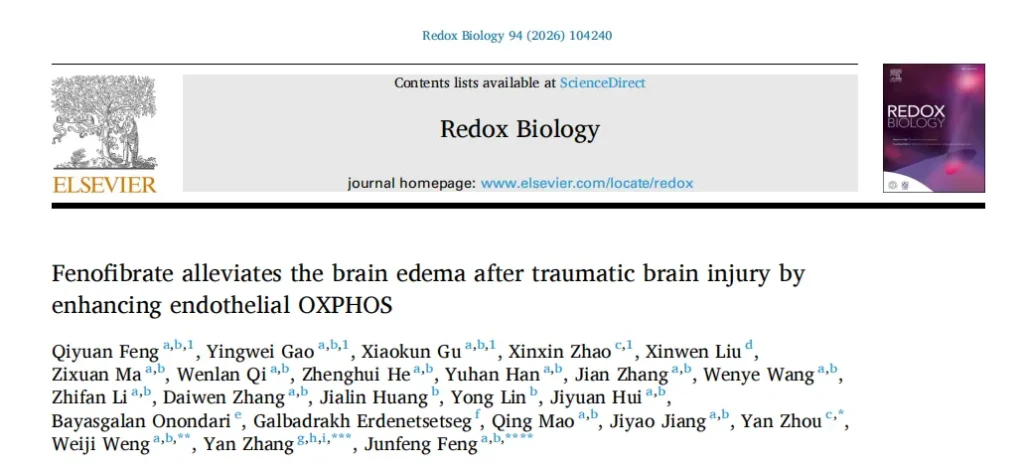
Recently, the team led by Junfeng Feng in the Department of Neurosurgery at Renji Hospital, Shanghai Jiao Tong University School of Medicine, published “Fenofibrate alleviates the brain edema after traumatic brain injury by enhancing endothelial OXPHOS” in Redox Biology. The original report cited an impact factor of 11.9. The study found that fenofibrate, a drug commonly used to lower lipid levels, could enhance oxidative phosphorylation in cerebral vascular endothelial cells after traumatic brain injury, protect blood–brain barrier integrity and reduce brain edema. The findings suggest a potential approach to addressing post-traumatic brain edema.
Traumatic brain injury (TBI) is an important cause of death and disability worldwide. Brain edema and the resulting rise in intracranial pressure can threaten the lives of patients with TBI and remain major challenges in neurosurgical care. Understanding how post-traumatic edema develops and identifying new treatment strategies are therefore important research goals.
In a mouse model of TBI, the research team found that fenofibrate reduced blood–brain barrier leakage, improved barrier integrity after injury, decreased edema volume and improved neurological outcomes. Further genetic experiments showed that the protective effect depended on PPARα in cerebral vascular endothelial cells. When endothelial PPARα was knocked out, the effects on edema, barrier protection and neurological recovery were markedly reduced or lost.
To investigate the molecular mechanism, the team conducted further work in vivo and in vitro. Fenofibrate activated PPARα and enhanced mitochondrial oxidative phosphorylation in injured endothelial cells, improving impaired energy metabolism and reducing reactive oxygen species accumulation and apoptosis. These effects protected blood–brain barrier integrity. The study identifies a potential mechanism by which fenofibrate may reduce edema following TBI and provides experimental evidence for exploring the repurposing of an established drug in this field.
Junfeng Feng of Renji Hospital Neurosurgery, Yan Zhang of the Second Affiliated Hospital of Nanchang University, Weiji Weng of Renji Hospital Neurosurgery and Yan Zhou of Renji Hospital Radiology are the co-corresponding authors. Qiyuan Feng, Yingwei Gao and Xiaokun Gu of Renji Hospital Neurosurgery, together with Xinxin Zhao of Renji Hospital Radiology, are the co-first authors. Jiyao Jiang, honorary chief expert at Renji Hospital and director of the Shanghai Institute of Head Trauma, provided important guidance for the study.
近日,上海交通大学医学院附属仁济医院神经外科冯军峰主任团队在国际知名期刊《Redox Biology》(IF 11.9)在线发表了题为“Fenofibrate alleviates the brain edema after traumatic brain injury by enhancing endothelial OXPHOS”的研究成果。该研究发现,临床常用降脂药非诺贝特可通过增强颅脑创伤后脑血管内皮细胞氧化磷酸化,继而保护血脑屏障完整性,从而减轻脑水肿。这一成果为颅脑创伤后脑水肿的药物治疗提供了新思路。
颅脑创伤(TBI)是全球范围内导致死亡和致残的重要原因之一。脑水肿及其引起的颅内压升高是危及TBI患者生命的重要原因,也是神经外科临床救治中的关键难题。因此,探索TBI后脑水肿的发生发展机制,并寻找新的治疗策略具有重要意义。
研究团队在小鼠TBI模型中发现,非诺贝特治疗可减少血脑屏障渗漏,增强损伤后血脑屏障的完整性,从而降低损伤后脑水肿体积,最终改善神经功能结局。进一步的遗传学证据显示,非诺贝特的保护作用依赖于脑血管内皮细胞中的PPARα:当内皮细胞PPARα敲除时,非诺贝特在减轻脑水肿、保护血脑屏障以及改善神经功能方面的效应明显减弱或消失。
为阐明其分子机制,研究团队在体内/外模型中进一步开展解析。结果发现,非诺贝特可通过激活PPARα增强受损内皮细胞线粒体氧化磷酸化,改善能量代谢障碍,继而减少活性氧(ROS)积累与细胞凋亡,从而保护血脑屏障完整性。该研究围绕TBI后脑血管内皮细胞能量代谢障碍,揭示了非诺贝特减轻TBI后脑水肿的潜在新机制,也为临床常用药物在TBI领域的再定位提供了实验依据。
上海交通大学医学院附属仁济医院神经外科冯军峰教授,南昌大学第二附属医院张焱教授,仁济医院神经外科翁维吉医师,仁济医院放射科周滟教授为本研究共同通讯作者。仁济医院神经外科冯启元、高颖蔚、顾晓琨,仁济医院放射科赵欣欣医师为本研究共同第一作者。仁济医院荣誉首席专家、上海市颅脑创伤研究所所长江基尧教授为本研究提供了重要指导。