Renji reports implantation of additively manufactured PEEK cranial implants
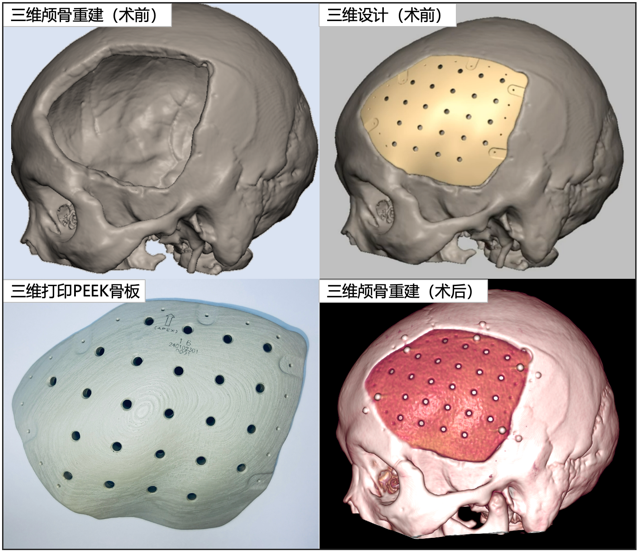
Director Junfeng Feng’s team at our Head Trauma Centre recently completed two implantations of additively manufactured polyetheretherketone (PEEK) prostheses for cranial defects. According to the original report, these were the first and second cranioplasties worldwide after certification of a PEEK cranial implant produced through powder-based 3D printing.
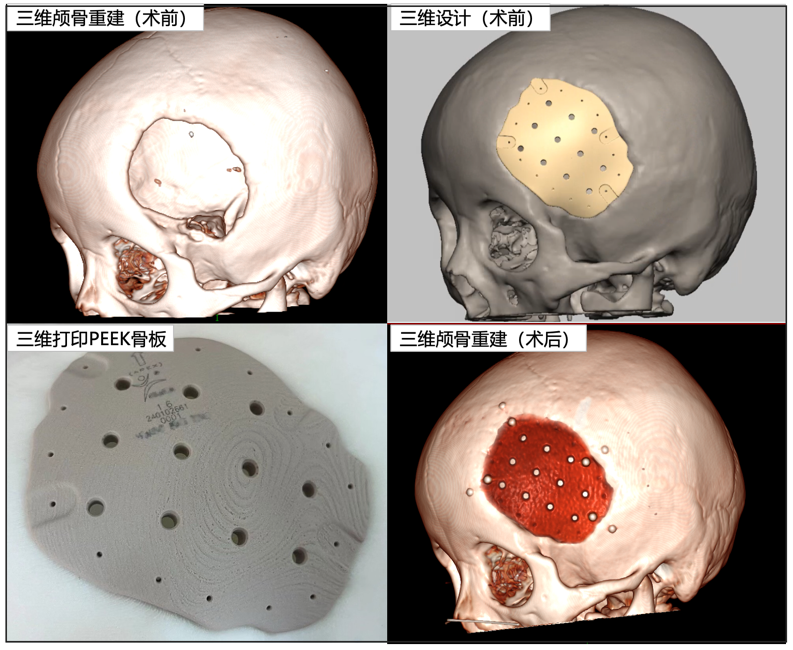
Patients with TBI, cerebral haemorrhage or skull disease may have bone removed during surgery and subsequently need an artificial material for reconstruction. PEEK has good tissue and imaging compatibility and has entered clinical use as a newer repair material. Conventional domestic and international manufacture uses machining that removes material—a subtractive process—rather than powder-based PEEK 3D printing.
The powder-printed implant introduces structural and performance changes. A polymer selective laser sintering (SLS) powder-bed process produces a hydrophilic interface and microcrystalline, sand-like surface to support cell adhesion and tissue growth. Regionally porous design may improve integration strength, while printing allows reconstruction of complex regions without joining separate pieces. The domestically developed and manufactured implant is designated a national innovative medical device, with multiple national patents and several first-of-their-kind developments.
Feng said clinicians are interested in cranioplasty standards, research and new devices and materials: “This product gives us more choices. Renji will conduct prospective multicentre studies to optimise procedures as materials and manufacturing develop, improve treatment results and work toward better reconstruction.” Several Chinese regions have introduced payment pathways supporting innovative medical devices, intended to reduce patient burdens while advancing care.
Expert profile
Junfeng Feng — Chief Physician
Renji Hospital, Shanghai Jiao Tong University School of Medicine
Chief physician, research professor and doctoral supervisor; Director of the Renji Head Trauma Centre and concurrently Deputy Director of Renji Neurosurgery; Deputy Director of the Shanghai Institute of Head Trauma; working-group member of the Chinese Medical Association’s Trauma Society; youth committee member of the Shanghai Medical Association’s Trauma and Neurosurgery Societies.
Honours include the Wang Zhongcheng Chinese Young Neurosurgeon Award, the Innovation Award of the Wang Zhengguo Trauma Medicine Award, the Shanghai Silver Snake Award, Shanghai Outstanding Academic Leader (Young) and Shanghai Outstanding Young Medical Talent.
He focuses on clinical surgery and comprehensive TBI and neurocritical care, and studies brain protection and neural repair and regeneration. He has received five NSFC grants, holds 20 granted patents and has published 30 SCI-indexed papers.
Professor Junfeng Feng
近日,我院颅脑创伤中心冯军峰主任团队成功完成了2例增材制造聚醚醚酮(PEEK)颅骨缺损修复假体植入手术。据悉,这是以PEEK粉末3D打印技术实施的增材制造PEEK骨板获证后,在全球的第1、第2例颅骨修补手术。
许多颅脑创伤、脑出血、颅骨病变等患者在手术中会去除颅骨,往往需要后期应用人工材料来做颅骨修补。聚醚醚酮(PEEK)的组织相容性和影像相容性好,被认为是新一代的人工修补材料,已经应用于颅骨修补临床手术中。但其制作工艺在国内外均为机加工,要把材料进行削减(减材工艺),还做不到PEEK粉末3D打印PEEK骨板。
此次首先使用的PEEK粉末3D打印PEEK骨板,从结构和性能上进行了全面升级:基于独特的高分子聚合物SLS(粉末床激光烧结)打印工艺,植入物表面形成了亲水界面和微晶砂样结构,有助于细胞粘附,促进组织生长;分区多孔设计,有利于提高植入物和组织融合后的结合强度;3D打印能够实现复杂部位更好的结构重建,无需拼接。这款3D打印PEEK骨板属于国家创新医疗器械,是由国内企业研发、生产的全新修补材料,荣获了多个国家专利,实现了多个第一。
冯军峰主任表示,临床医生和专家都很关注颅骨修补,包括相关的操作规范、临床研究、新器械材料应用等等。“这款产品的出现,为我们的手术提供了更多的选择。仁济团队也将开展前瞻性多中心研究,在材料及工艺发展的同时,优化操作流程,提升救治效果,共同助力‘完美修补’!”目前,全国已有多地在支付环节为创新医疗器械留出绿色通道,在减轻群众就医负担的同时,促进医疗技术水平发展,进一步提升大众健康水平。
专家简介
冯军峰 主任医师
上海交通大学医学院附属仁济医院
主任医师、研究员、博士研究生导师
上海交通大学医学院附属仁济医院颅脑创伤中心科主任
兼任仁济医院神经外科科室副主任
上海市颅脑创伤研究所副所长
中华医学会创伤学分会学组委员
上海市医学会创伤学分会、神经外科学分会青年委员
获王忠诚中国神经外科青年医师奖、王正国创伤医学奖创新奖、上海市银蛇奖、上海市优秀学术带头人(青年)、上海市杰出青年医学人才
专注于颅脑创伤、神经重症相关临床手术及综合救治,开展脑损伤保护和神经修复再生研究。获国家自然科学基金5项、授权专利20项、发表30篇SCI论文